
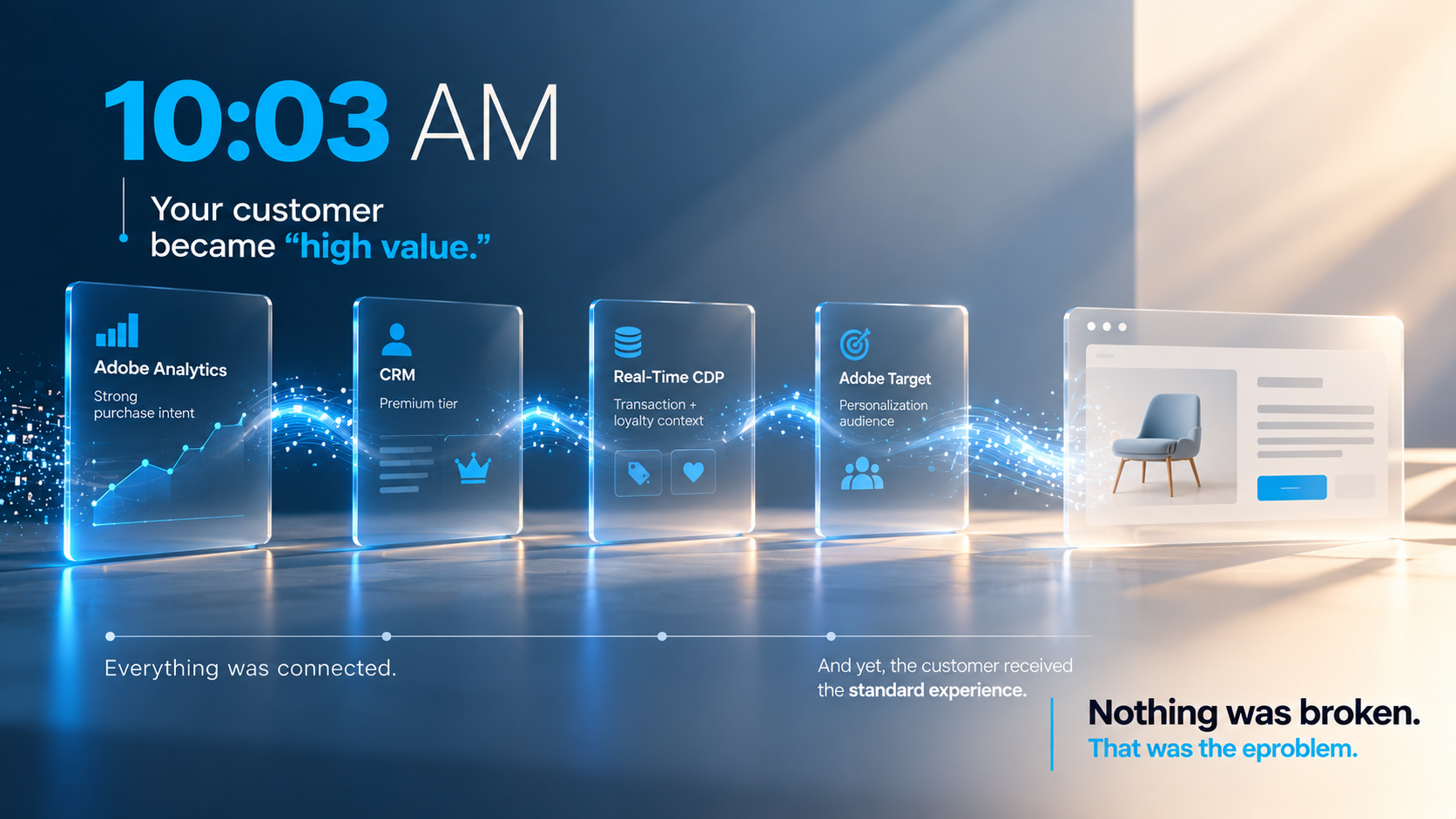
For a large enterprise, this situation is not necessarily a failure of Adobe Analytics, Real-Time CDP or Adobe Target. Adobe's current architecture is specifically designed to bring together known and anonymous data, create customer profiles and make audiences and profile attributes available to Target for personalization. The current integration also supports real-time audience evaluation at the Edge for same-page and next-page personalization.
The more interesting question begins after the connection has been established. Does every system agree on what the customer signal actually means? That is where the Enterprise Context Gap appears.
Consider a global enterprise operating across several brands, markets and business units. The CRM team may define a high-value customer according to lifetime revenue and loyalty status, while the digital team uses recent behavior in Adobe Analytics to identify visitors showing strong purchase intent. The customer data team may combine transactions, loyalty information, CRM attributes and behavioral signals in Real-Time CDP, while the personalization team builds a Target audience around eligibility and contextual attributes.
None of those definitions has to be wrong. The problem begins when they are treated as if they were interchangeable. A customer can have high lifetime value without being ready to purchase today. A visitor can demonstrate strong purchase intent without belonging to a premium loyalty tier. A customer can qualify for a loyalty experience while a recent behavioral signal should trigger a completely different intervention.
In a large organization, these distinctions can disappear inside audience names, campaign rules, classifications and reporting conventions. Teams continue to use the same words while referring to slightly different populations. The architecture remains operational, but the business interpretation starts to drift.
Connected data does not automatically create shared meaning.
That distinction becomes increasingly important as Adobe makes the distance between analytics, audience activation and personalization shorter.
Adobe's current Real-Time CDP and Target integration supports multiple personalization patterns, including real-time Edge evaluation and streaming or batch audience sharing. In an Edge-based implementation, customer context can be evaluated before the personalization request reaches Target, allowing profile attributes and audiences to contribute to same-page or next-page experiences. This is a significant architectural evolution because the organization no longer has to think about analytics and personalization as completely separate stages of the customer journey. The signal can move closer to the decision. But moving the signal faster creates a new requirement.
The context has to be right when the decision is made.
This is why the more advanced Adobe architecture question is no longer simply whether Analytics can measure a behavior or whether Target can personalize an experience. The question is whether the business definition attached to that behavior remains consistent as it moves through identity, profile, audience qualification, decisioning and measurement. This is also the direction explored in Devrun's analysis of Adobe's August 2026 updates, where the common thread was the shortening distance between signal, context and action rather than any individual feature.
Imagine the customer from the opening scenario again. Adobe Analytics identifies a sequence of behaviors associated with strong purchase intent. Real-Time CDP enriches the profile with transaction and loyalty information. An audience becomes available to Target, and Target has the information required to personalize the experience.
Technically, the journey can be completely valid. The challenge is the business logic behind it. A high-value customer needs a clearly defined qualification rule, an accountable owner, and a known validity period. That definition should remain consistent across Analytics, CRM, Real-Time CDP, and Target. Otherwise, Target may receive the qualification signal without the context behind it—creating a technically successful experience that may still lead to the wrong business decision. This highlights a critical distinction: qualifying an audience is not the same as making a business decision.
An audience answers who qualifies. A business decision answers why the experience should change now. When those concepts become blurred, an enterprise can end up optimizing audiences without fully validating the business context behind them.
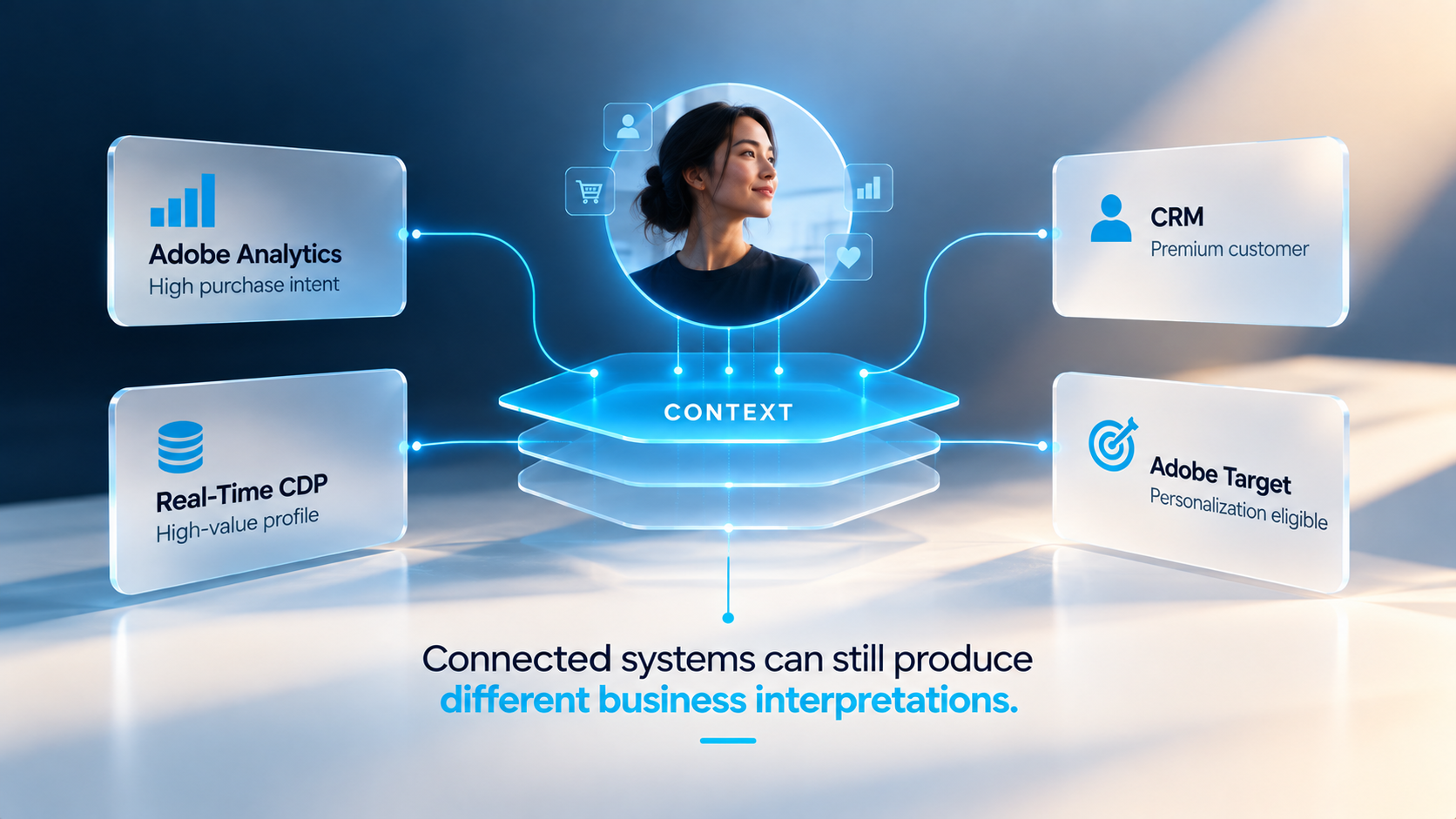
This graphic illustrates the enterprise context gap: a single customer can be interpreted differently across connected MarTech systems. Adobe Analytics may identify strong purchase intent, the CRM may classify the customer as premium, Real-Time CDP may recognize a high-value profile, while Adobe Target determines personalization eligibility. The systems can be technically connected and still operate from different business definitions, audience logic, and decision contexts. The key message is simple: connected data does not automatically create a shared customer meaning.
The same issue appears after the experience is delivered. Analytics for Target, or A4T, creates a measurement relationship between Analytics and Target. Adobe documents A4T support for Target activities, including Auto-Allocate and Auto-Target, with Analytics metrics available as goal metrics for optimization. This creates a powerful loop in which customer behavior can inform an audience, the audience can inform an experience, and the resulting outcome can return to Analytics for measurement. But there is an important distinction.
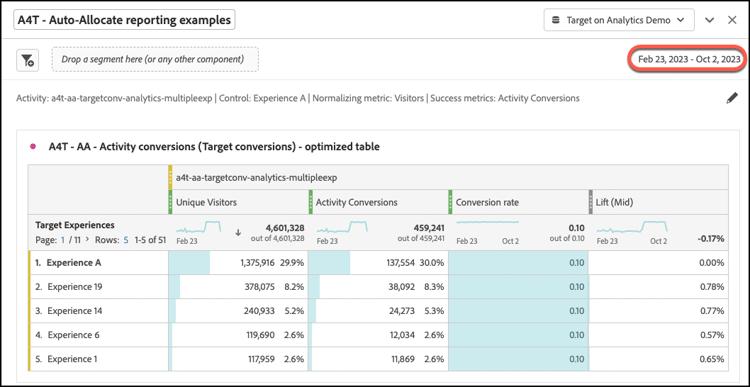
Measurement can tell you whether the selected outcome changed. It does not automatically prove that the audience represented the right business population.
This becomes particularly interesting with Auto-Target. Adobe describes Auto-Target as using machine learning to select the most appropriate experience for each visitor based on profile, behavior and context, while optimizing against a selected goal metric.
That means the architecture is no longer simply answering:
What happened?
The Signal Integrity Test is a Devrun diagnostic framework designed to test whether the meaning of a customer signal remains reliable across the full decision journey.
It follows the chain from Signal — what happened — to Context — what it means — then Audience, Decision, Experience, and Outcome, before returning to the next customer interaction. The framework shifts the focus from individual Adobe capabilities to the integrity of the business logic connecting them, asking a critical enterprise question at every stage: Can you prove the chain?
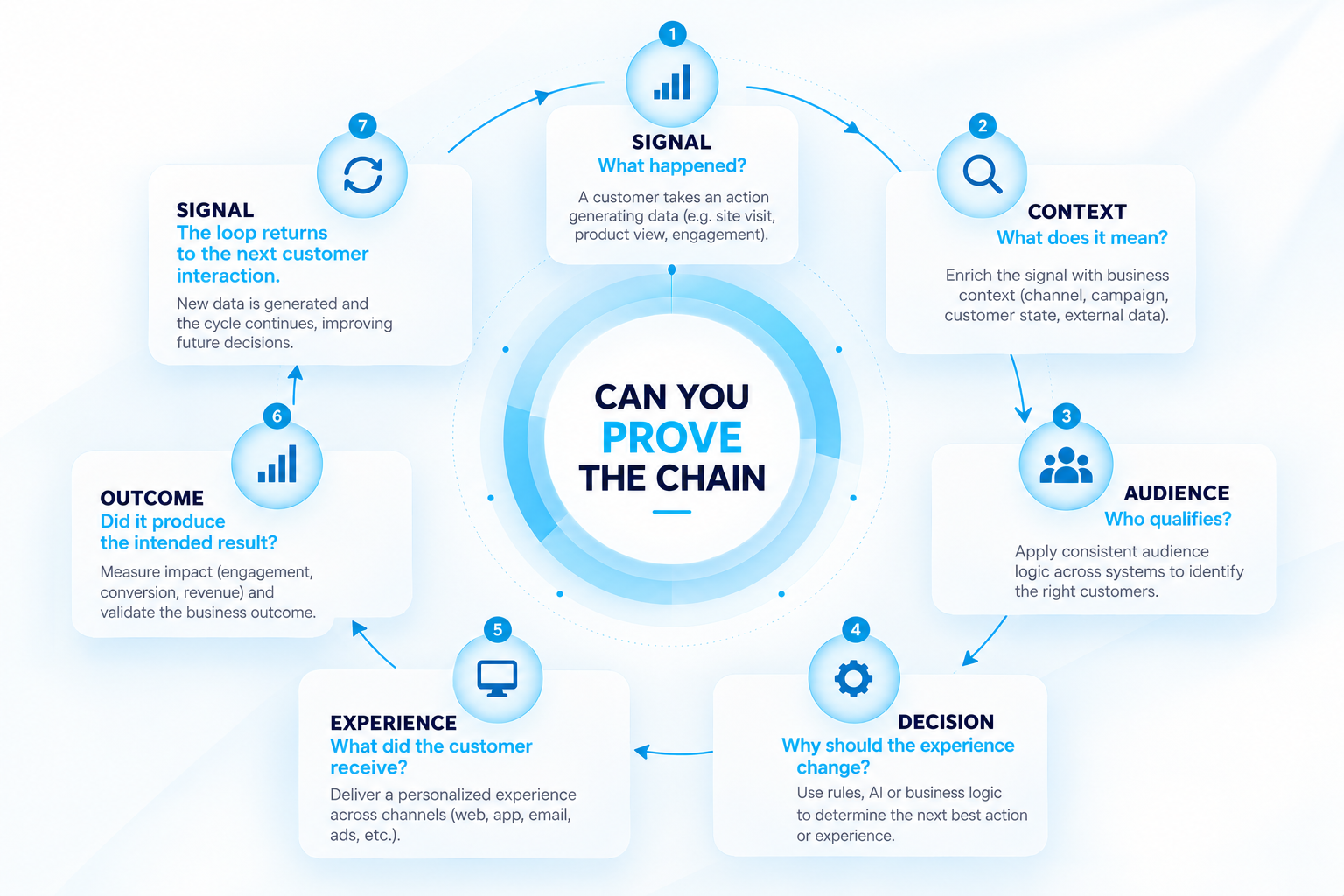
The framework becomes more actionable when each layer is tested against a specific enterprise question. The table below translates the Signal Integrity Test into practical checkpoints for assessing where context, meaning, or decision logic can break across the MarTech architecture.
The important word here is same. Not simply whether the data exists, whether the audience is active or whether Target delivered the experience. The real question is whether every relevant layer is answering the same business question.
This issue extends beyond Adobe Target. Gartner's 2026 research argues that AI agents require context, including semantic representations of data, to operate accurately and efficiently. Gartner specifically recommends establishing a context layer as part of the data and analytics infrastructure because traditional schema-based models alone do not necessarily provide sufficient business meaning.
Gartner's 2026 roadmap for data and analytics governance similarly argues that traditional governance approaches need to evolve to support AI-enabled organizations. For Adobe teams, the implication is particularly relevant. A more intelligent personalization system does not eliminate the need for business definitions. It increases their importance because the system can act on those definitions faster and at greater scale.
Better automation requires better context.
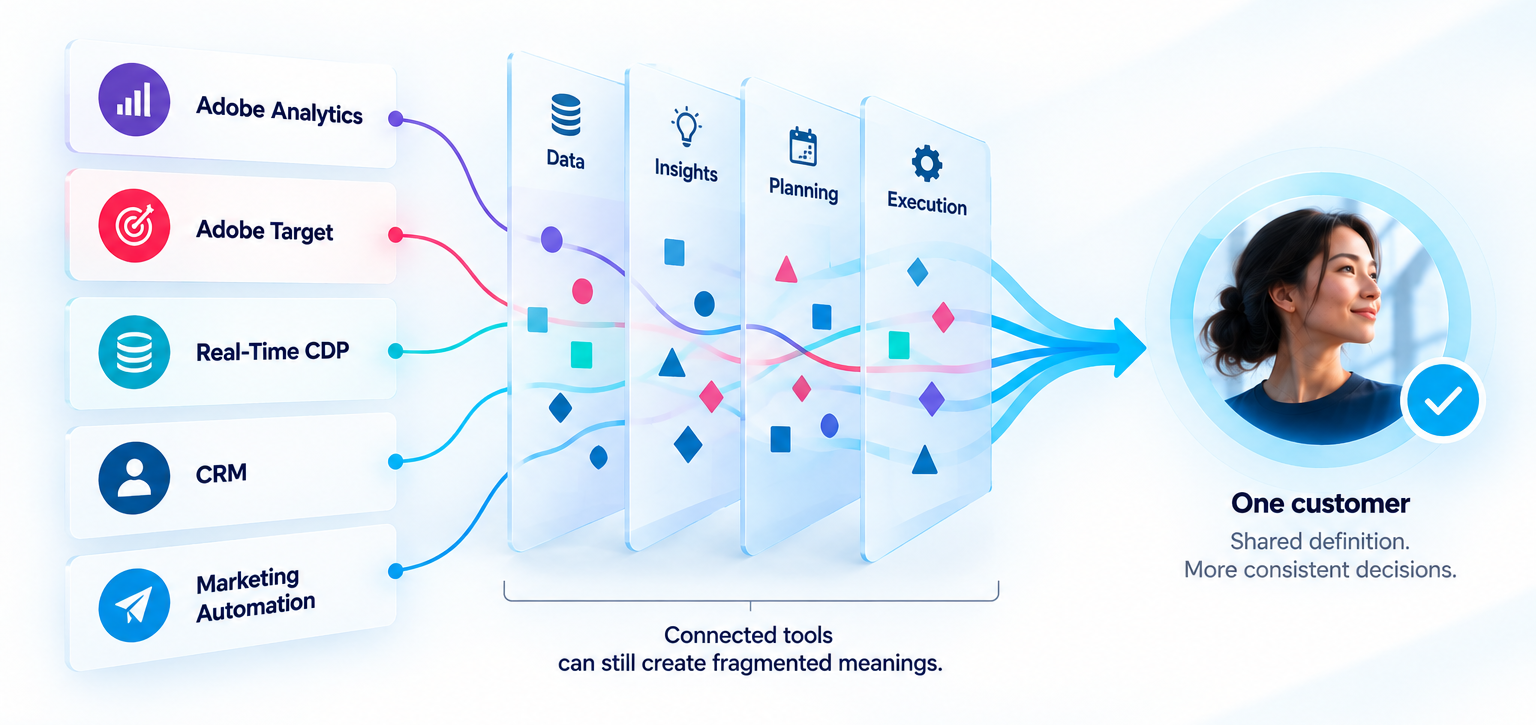
Forrester's Total Economic Impact study, commissioned by Adobe, describes how fragmented technology approaches can create silos across customer data, insights, marketing planning and execution. Its research was based on interviews with four organizations, a survey of 116 employees using Adobe Experience Cloud and a modeled composite organization. The study reported a 333% modeled ROI and a $41.5 million modeled net present value over three years for that composite organization. Those figures are specific to the study's methodology and assumptions rather than a universal Adobe business case.
The more useful lesson for this article is the architectural one: integration can reduce fragmentation, but integration alone does not determine whether an organization has one coherent business definition of its customer. That remains a governance and decision problem.
The enterprise in our opening story did not necessarily need another Adobe capability. It needed to understand why several systems could hold valid information about the same customer while still producing an experience that did not reflect the intended business context.
That is the shift from implementation confidence to decision confidence.
Implementation confidence asks whether the data is flowing correctly. Decision confidence asks whether the organization can trace a meaningful signal from its business definition through customer profile, audience qualification, Target decision, experience delivery and final measurement without losing the context that made the signal valuable in the first place. Adobe is making that journey increasingly connected. The opportunity for enterprise teams is to make the connection meaningful.
Because the next advantage in MarTech may not come from collecting another signal or activating another audience. It may come from knowing exactly what the signal means when the decision is made. Your Adobe stack already knows your customer. Analytics knows the behavior. Real-Time CDP can enrich the profile. Target can personalize the experience. A4T can connect activity with Analytics measurement. The question is whether they all agree on who that customer is and what that customer means right now.
That is where the next layer of Adobe performance begins. Find the context gap before it becomes a customer experience problem.