
The rapid adoption of generative AI has created the impression that better business decisions are simply a matter of choosing the right language model. Organizations compare GPT, Claude, Gemini, and other platforms, evaluate reasoning capabilities, and experiment with AI assistants that promise to summarize reports, answer analytical questions, or recommend the next best action.
While these technologies continue to improve at an extraordinary pace, early enterprise deployments have revealed a recurring limitation. Although AI can interpret information with remarkable fluency, the quality of its recommendations depends far less on the sophistication of the model than on the business knowledge available to it. For marketing analytics teams, this fundamentally changes the conversation: competitive advantage is no longer defined by access to more powerful AI, but by the ability to provide AI with the organizational context it needs to understand how the business actually operates.
Enterprise AI is only as effective as the business context it can access. The diagram below illustrates how marketing data, governance, and organizational knowledge work together to transform AI into trusted decision-making.
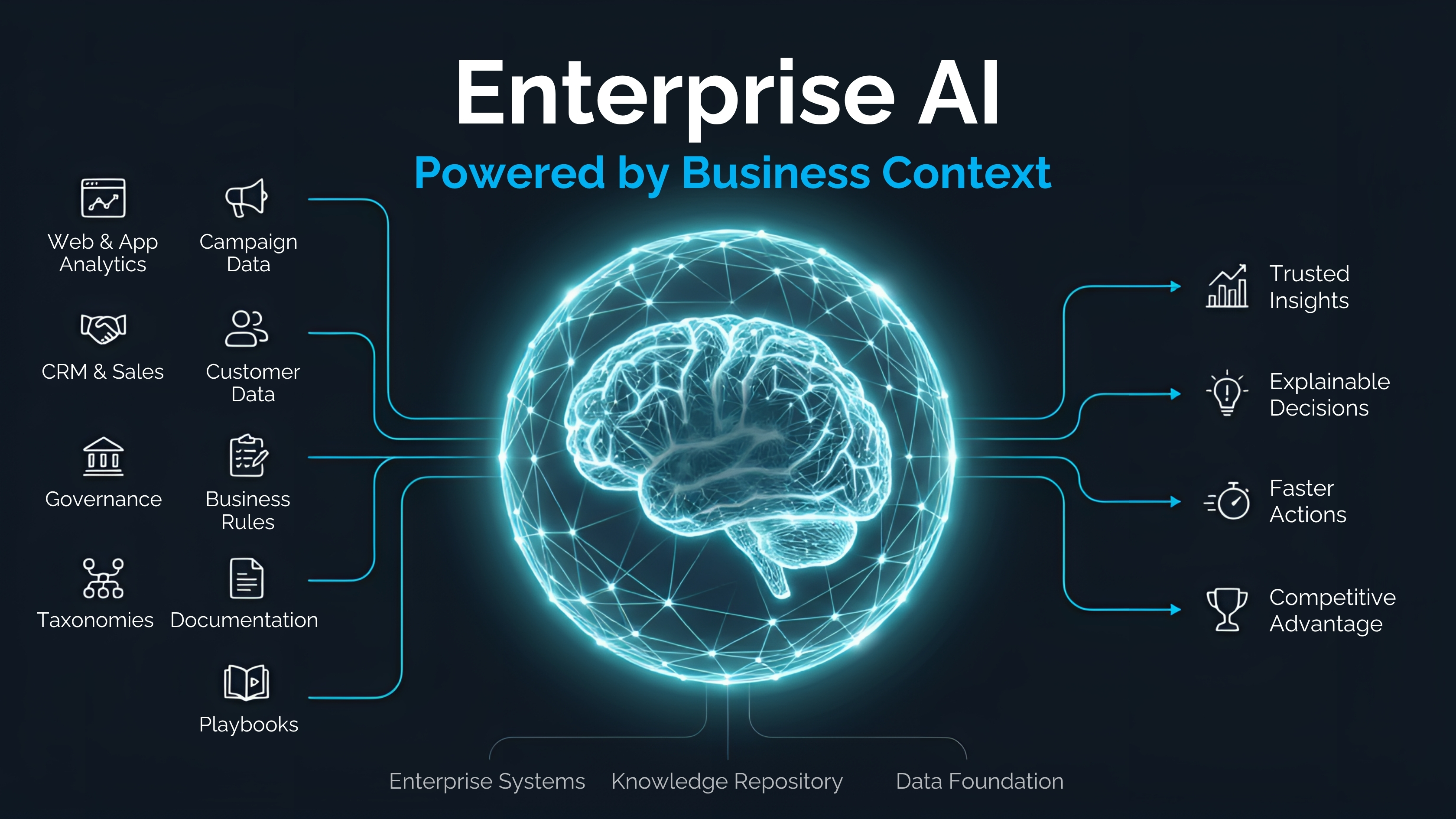

Enterprise organizations have invested heavily in analytics ecosystems. Google Analytics 4, Adobe Analytics, CRM platforms, cloud data warehouses, and business intelligence tools provide unprecedented visibility into customer behaviour and marketing performance. Yet despite this abundance of data, answering a simple business question often requires far more than a dashboard.
Recent Google Analytics updates, including GA4 Source Group and Source Platform, further improve acquisition data consistency, helping organizations build more reliable measurement before AI interprets business context.
Consider a quarterly business review where leadership asks why marketing-generated pipeline declined despite increased media investment. Reports may reveal lower conversion rates, fewer qualified opportunities, or changes in channel contribution, but they rarely explain whether those results were influenced by a revised attribution model, a Consent Mode implementation, tracking changes, or inconsistencies in campaign taxonomy. Those answers typically reside in governance documents, implementation history, release notes, and business rules rather than in the analytics platform itself.
Experienced analysts naturally combine performance data with this organizational knowledge before drawing conclusions. AI must be able to do the same if it is expected to generate reliable business MarTech insights rather than simply summarize reports.
Every analytics program accumulates knowledge that rarely appears in reports but fundamentally shapes how those reports should be interpreted. KPI definitions, governance standards, tracking specifications, campaign taxonomies, implementation decisions, and business rules provide the context behind the data.
Historically, this information served as supporting documentation for analysts. Today, it has become a critical source of context for AI. Enterprise AI platforms increasingly combine language models with organizational knowledge, whether through Retrieval-Augmented Generation (RAG), enterprise search, or similar approaches, allowing responses to incorporate internal documentation, governance standards, and implementation history instead of relying solely on pre-trained knowledge.
Business knowledge is no longer just an operational asset. When properly governed and connected to analytics, it enables AI to deliver trusted, actionable insights that support faster and more confident business decisions.
As AI becomes increasingly embedded in enterprise analytics, the role of analytics is evolving beyond measuring performance. Modern AI systems combine structured marketing data with organizational knowledge to deliver insights that are more contextual, explainable, and aligned with business objectives.
Retrieval-Augmented Generation illustrates this evolution particularly well. Rather than generating responses exclusively from the statistical relationships learned during model training, a RAG architecture retrieves relevant enterprise information before asking the language model to produce an answer.
For a marketing analytics team, that information might include KPI definitions, analytics implementation guides, governance policies, CRM records, release notes, tracking specifications, campaign taxonomies, or historical documentation explaining why measurement decisions were made. The language model is therefore able to interpret reported metrics within the same business context that experienced analysts naturally consider during their investigations.
The value of this approach extends beyond improving factual accuracy. It enables AI to produce recommendations that align with the organization's own definitions, governance practices, and analytical standards instead of relying solely on generalized knowledge.

Imagine a marketing director investigating a decline in conversions despite higher campaign investment. While dashboards highlight the performance change, the explanation often lies elsewhere, in attribution updates, tracking implementations, governance standards, or business rules. By retrieving this organizational knowledge, AI gains the context needed to produce reliable, explainable, and actionable insights.
The diagram below illustrates how AI generates more reliable and actionable insights when enterprise knowledge is integrated into the analytical process. Rather than relying solely on marketing data, AI can retrieve governance standards, KPI definitions, implementation documentation, campaign taxonomies, CRM information, and historical decisions to interpret performance within the proper business context. This combination of data and organizational knowledge transforms AI from a reporting assistant into a trusted decision-support system.
The following diagram illustrates how enterprise AI combines marketing data with organizational knowledge to generate trusted, explainable, and actionable business insights.

The growing adoption of AI is unlikely to reduce the importance of governance, documentation, or implementation standards. If anything, it will make deficiencies in those areas considerably more visible.
Inconsistent KPI definitions, fragmented governance, undocumented implementation changes, or outdated tracking specifications have always affected reporting quality. Analysts learned to compensate by relying on experience and institutional knowledge. AI has no such advantage unless that knowledge has been deliberately preserved and made accessible.
This is why investments in analytics governance should increasingly be viewed as investments in AI readiness. Organizations that maintain trusted documentation, standardized business definitions, and well-governed analytical processes provide AI with the information required to generate recommendations that are transparent, explainable, and consistent with business reality.
Before organizations can fully benefit from AI, they need more than high-quality marketing data. AI requires trusted business context to generate accurate and explainable recommendations. An AI-ready analytics program is built on consistent governance, reliable documentation, and standardized business definitions that remain accessible over time.
Organizations should evaluate whether their analytics ecosystem provides AI with the information it needs to reason effectively.
Before AI can generate reliable recommendations, it needs access to more than marketing data. Organizations should evaluate whether their analytics ecosystem provides the governance, documentation, and business context required for AI to reason effectively.
Organizations that consistently maintain these capabilities provide AI with the context required to deliver reliable, explainable, and actionable business Martech insights.
As AI becomes a standard capability across enterprise organizations, the technology itself will become less of a differentiator. Competitive advantage will increasingly depend on the quality of the business knowledge that organizations preserve, govern, and make accessible.
The companies that generate the greatest value from AI will not necessarily have the most advanced language models. They will be the ones that combine trusted marketing data with governance, documentation, and organizational knowledge, giving AI the context it needs to deliver reliable, explainable, and actionable insights.