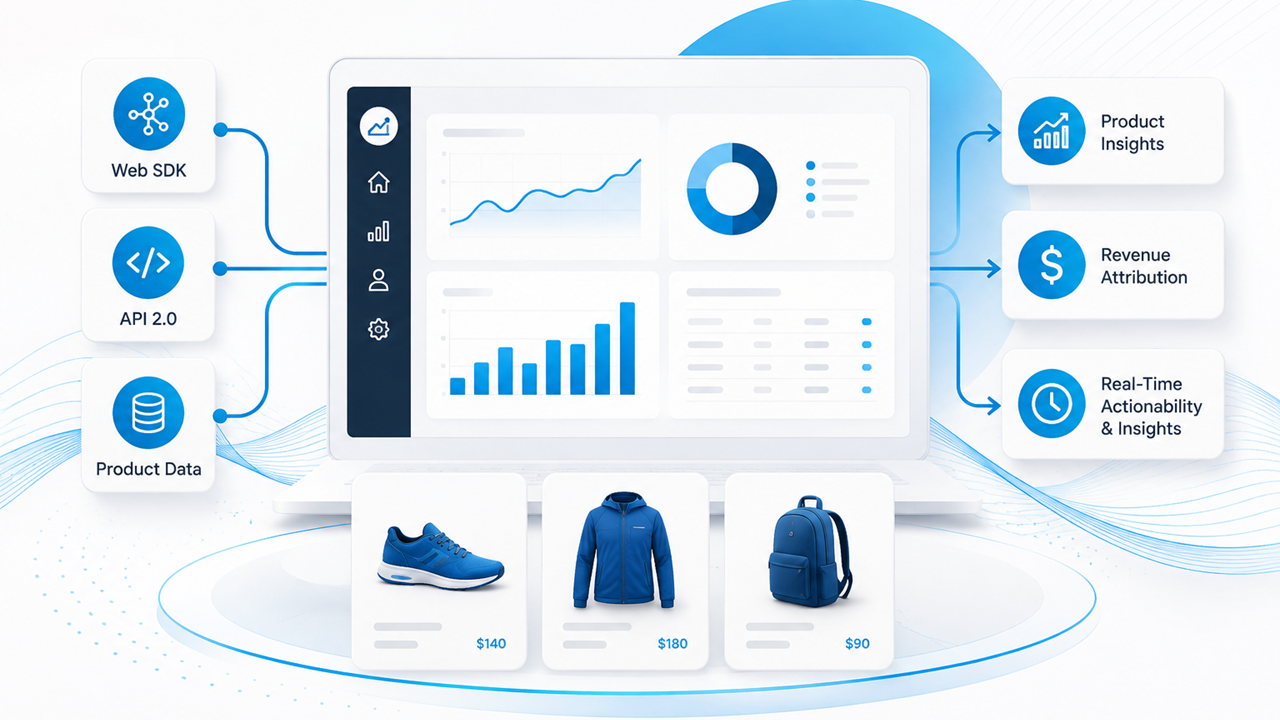
Every Adobe Analytics release introduces new capabilities that promise better measurement, reporting, and customer insights. Yet for many organizations, new features rarely translate into immediate business value.
Adobe's July 2026 release illustrates this challenge well. While these updates introduce meaningful improvements, organizations with fragmented implementations or legacy configurations may struggle to maximize their value. As discussed in Adobe Analytics May 2025 Updates for Smarter Customer Intelligence, strong analytics foundations remain essential for getting the most from every Adobe Analytics release.
For enterprise teams, the real opportunity isn't simply adopting new functionality. It's using these enhancements to improve real-time actionability and insights, strengthen reporting confidence, and make faster, more informed business decisions.
Adobe Analytics focused this release on improving reporting flexibility, enterprise integrations, and modern implementation support.
Although none of these features radically changes Adobe Analytics overnight, together they continue Adobe's shift toward a more connected, modern analytics platform capable of supporting increasingly complex enterprise environments.
Here are the four most important takeaways from the July 2026 release;

Among the July enhancements, Sub-hit Analysis is arguably the most significant for organizations with complex eCommerce implementations.
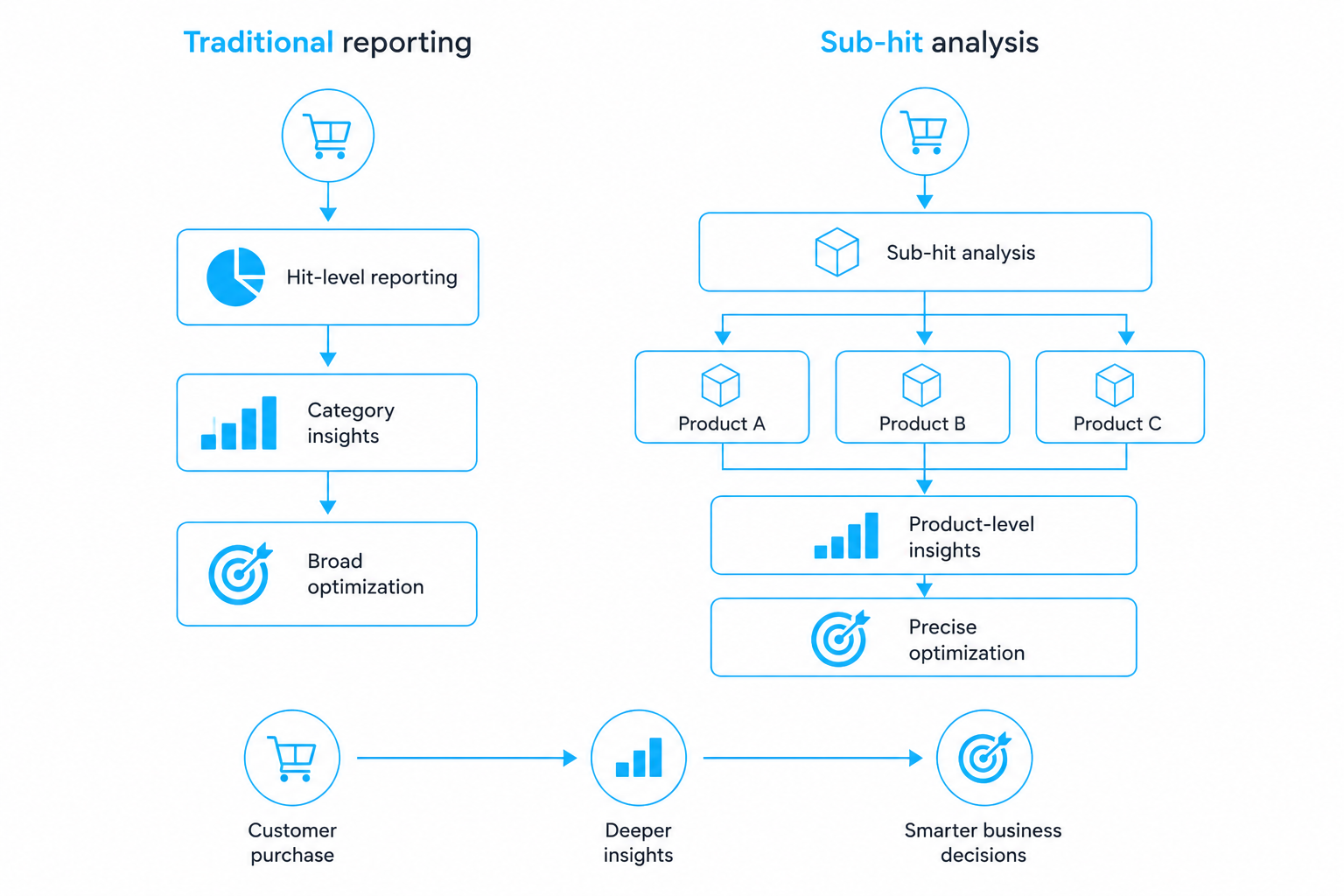
Sub-hit Analysis shifts reporting from category-level visibility to product-level decision-making.
Many organizations immediately ask: "Should we enable these new capabilities?"
The better question is: "Is our analytics implementation ready?"
New reporting capabilities cannot compensate for inconsistent measurement, disconnected data, or poor governance.
Can you answer "Yes" to the following questions?
If you answered "No" to any of these questions, your organization may not be fully prepared to maximize the July 2026 Adobe Analytics updates. Organizations with a simplified MarTech ecosystem and trusted measurement are best positioned to transform these updates into real-time actionability and insights.
Adobe also introduced Activity Map support for Adobe Experience Platform Web SDK, allowing organizations to modernize their implementation without sacrificing click-tracking capabilities.
For teams migrating from AppMeasurement, this update simplifies the transition while maintaining visibility into on-page user interactions. A modern Web SDK implementation also provides a stronger foundation for connected data across the broader MarTech ecosystem.
One of the most practical applications of Sub-hit Analysis is improving product-level revenue attribution. Consider an apparel retailer where customers frequently purchase multiple products within a single order. The following simplified scenario illustrates how traditional hit-level attribution differs from Sub-hit Analysis.
Customer Order
The marketing team wants to evaluate the performance of the Men's Running Shoes category after launching a paid advertising campaign.
Traditionally, Adobe Analytics processes segments at the hit level. If analysts create a segment for Men's Running Shoes, the entire order is included because all products belong to the same hit.
Although only one product belongs to the selected segment, the complete order value is attributed to that hit. This can overstate product performance and reduce the accuracy of merchandising analysis. With Sub-hit Analysis, segmentation occurs at the individual product level rather than the hit level.
Marketing and merchandising teams can now evaluate product performance using only the revenue associated with the selected product.
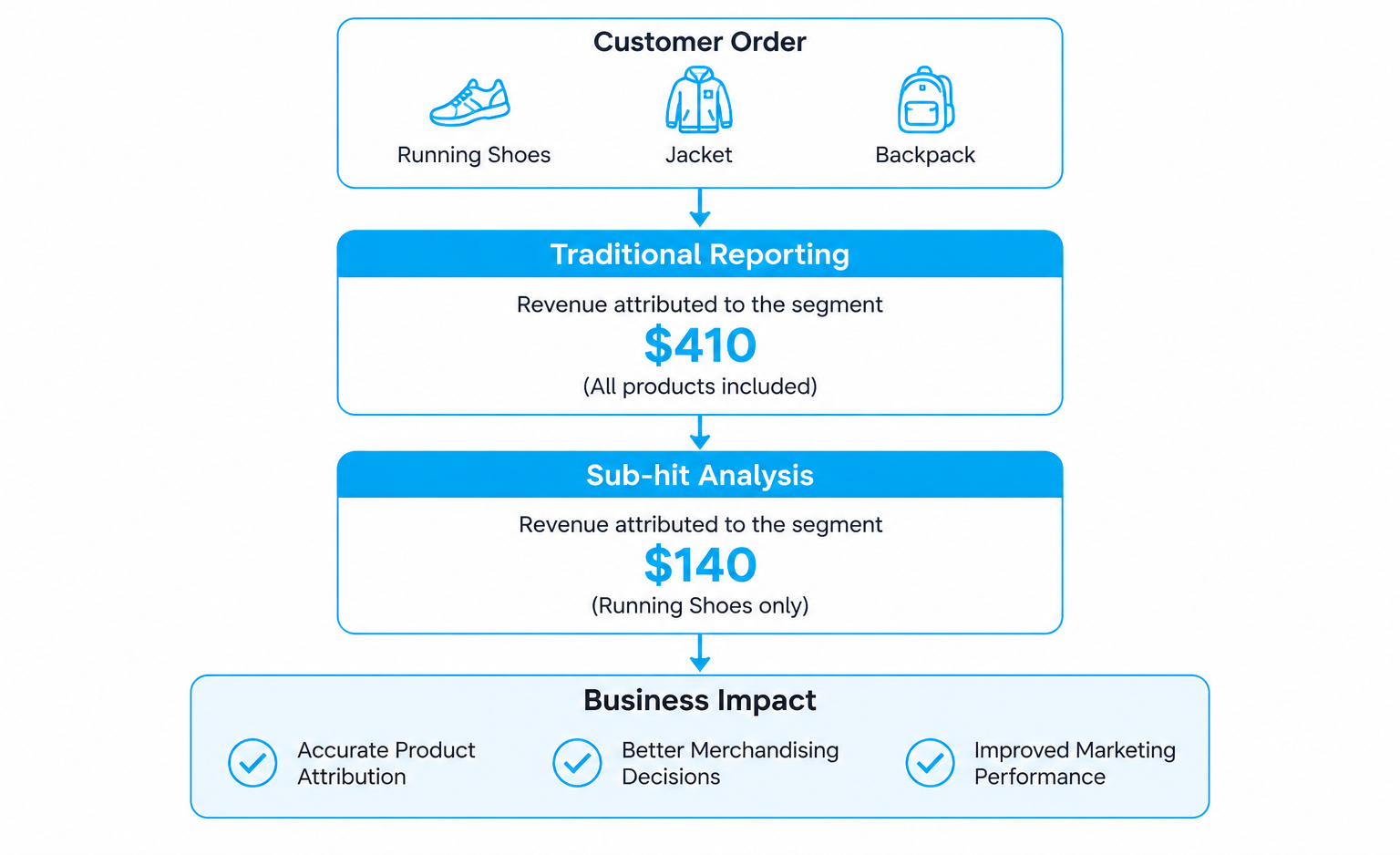
The comparison clearly demonstrates how Sub-hit Analysis improves revenue attribution by isolating the performance of individual products rather than attributing the value of an entire order. This enables more accurate merchandising analysis, better campaign measurement, and more confident business decisions.
For enterprise retailers managing thousands of products, even small improvements in measurement can lead to more confident merchandising decisions.
Sub-hit Analysis helps organizations:
While the feature may appear technical, its value extends well beyond reporting. Better measurement enables more confident business decisions, more effective merchandising strategies, and stronger marketing optimization across the broader MarTech ecosystem.
Before adopting Sub-hit Analysis, verify that your implementation includes:
Organizations with well-governed implementations will be able to take advantage of this feature much more quickly than those relying on legacy tracking standards.
While these new capabilities are valuable, many organizations may discover that their current implementation limits adoption. Some of the most common challenges include:
For many enterprise organizations, implementation quality, not software capability, becomes the limiting factor. The Adobe Analytics July 2026 updates are more than a collection of new features. They provide an opportunity to evaluate whether your analytics foundation is ready for the next generation of enterprise measurement.
Organizations that invest in MarTech, trusted measurement, and connected data will be best positioned to transform the July 2026 updates into real-time actionability and insights and measurable business outcomes.

🔗 Sources:
Adobe Experience League