AI is no longer augmenting analytics workflows. It is beginning to reshape how organizations activate, optimize, and operationalize marketing intelligence in real time.
The latest Google Analytics updates reinforce this shift toward AI-assisted analysis, predictive intelligence, and faster operational decision-making across increasingly complex MarTech ecosystems.
For large brands managing fragmented data environments, disconnected activation platforms, and growing governance pressure, these updates represent far more than product enhancements. They expose a growing divide between scalable analytics operations and modern MarTech environments struggling to support AI-driven execution.
Google’s latest GA4 enhancements place artificial intelligence directly inside the analytics workflow.
Enterprise teams can now:

Recent Gartner, McKinsey, and Forrester research highlights a growing focus on AI-powered analytics, real-time intelligence, and faster activation across modern MarTech environments. The same research also points to increasing challenges around governance, fragmented customer data, and operational scalability.
The table below highlights how current enterprise analytics research is influencing AI adoption, governance priorities, and operational risks across modern MarTech ecosystems.
Complexity is becoming an operational liability. For teams already managing disconnected reporting systems, growing governance requirements, and multiple activation platforms, these new capabilities create both opportunity and pressure. Without structured governance, even advanced AI models can amplify poor analytics decisions at scale.
One of the most important May 2026 updates involves improved visibility into AI-generated traffic sources. As conversational AI assistants increasingly influence online discovery, traditional SEO reporting no longer provides a complete understanding of digital performance.
Traffic may now originate from:
This creates an entirely new analytics challenge. Enterprise teams now face new measurement priorities, including:
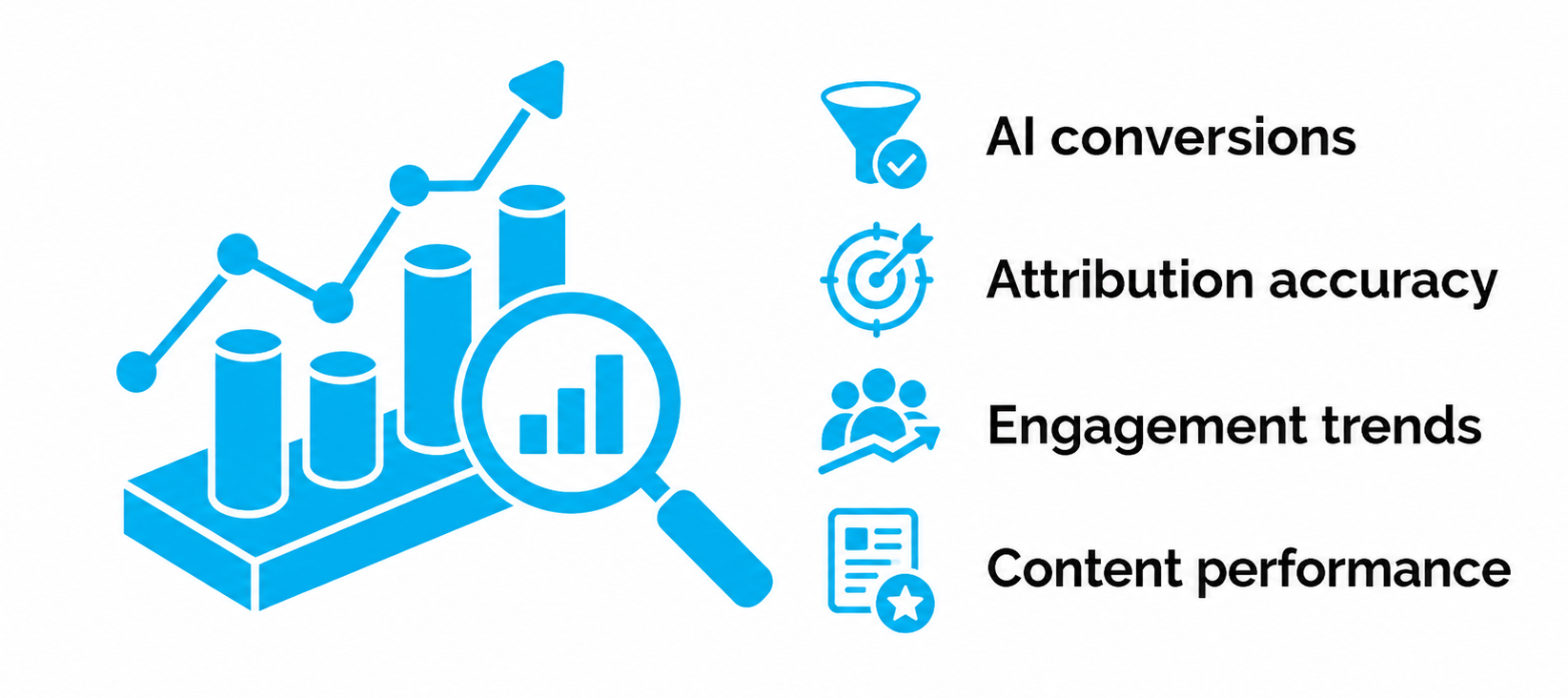
AI-powered analytics is increasing the gap between scalable MarTech ecosystems and fragmented data environments.
For organizations operating large-scale digital ecosystems, this shift increases the importance of governance maturity, operational consistency, and scalable data structures. Otherwise, AI-generated traffic data quickly becomes difficult to interpret accurately.
Many organizations still operate with fragmented data, inconsistent tracking, and disconnected MarTech integrations. These operational gaps reduce AI analytics performance and slow decision-making.
The May 2026 GA4 updates reinforce the importance of centralized governance, scalable data structures, and simplified integrations to fully support AI-driven analytics.
Google also expanded its AI-assisted analysis experience through Analytics Advisor inside GA4.
Users can now ask natural-language questions directly inside the platform and receive automated explanations regarding:

This dramatically reduces analytical friction across complex reporting environments.
Instead of manually navigating dashboards and reports, analytics teams can identify performance changes faster and activate optimization opportunities more efficiently. However, AI-generated recommendations remain highly dependent on data quality.
Organizations with inconsistent tracking logic or poorly structured implementations risk generating misleading insights at scale. This is where MarTech simplification becomes a competitive advantage rather than a technical preference.
Coca-Cola’s analytics modernization with Google Cloud reflects a growing enterprise trend toward simplified reporting environments and faster operational intelligence. By centralizing analytics and improving data accessibility, organizations can improve activation speed, personalization, and strategic decision-making across the customer journey.
According to IBM, over a quarter of organizations estimate losing more than $5 million annually due to poor data quality and fragmented analytics environments.
Google’s new lifecycle audience templates also represent an important operational advancement for modern MarTech environments.
Enterprise teams can now activate audience strategies more efficiently around:
This reduces the time required to operationalize analytics insights into advertising actions.
The table below highlights how the latest Google Analytics May 2026 capabilities could influence MarTech performance, activation speed, and operational efficiency.
The May 2026 Google Analytics updates demonstrate how enterprise analytics is evolving toward AI-assisted operational intelligence. The organizations gaining the most value from this transformation will not necessarily collect more data. They will reduce operational friction faster than everyone else.

Google Analytics Help Center
https://support.google.com/analytics/answer/9164320
Google Cloud
https://cloud.withgoogle.com/next
Gartner
https://www.gartner.com/en/data-analytics
Forbes
https://www.forbes.com/councils/forbestechcouncil/
Forrester
https://www.forrester.com/report/predictions-2026-data-and-analytics/RES182545
IBM
https://www.ibm.com/think/insights/cost-of-poor-data-quality